
Sacred Varanasi Tour reveals Ganga Aarti Varanasi timings 2026 — exact schedules, the 5 best viewing spots, boat booking tips and safety advice.
Ganga Aarti Varanasi Timings 2026: 5 Best Viewing Spots Revealed
Every evening, as the light drains out of the sky over Kashi, something happens at Dashashwamedh Ghat that has happened, in some form, for centuries. Knowing the exact Ganga Aarti Varanasi timings 2026 — and where to stand — turns this from a spectacle you glimpse over someone’s shoulder into an experience you actually feel.
Conch shells sound. Bells begin. Young priests in saffron step onto seven raised platforms, lift towering brass lamps, and begin moving them in slow, fire-drawn circles over the Ganga. According to Wikipedia’s entry on Dashashwamedh Ghat, this Aarti is held daily at dusk without exception, rain or shine.
This guide gives you the confirmed Ganga Aarti Varanasi timings 2026, the five best places to watch from, and what the ritual actually means.

What Is the Ganga Aarti?
Aarti is the Hindu ritual of offering light to the divine. Here, the divine is the river herself — Ganga Maa, believed to have descended from the heavens and been caught in Shiva’s matted hair to break her fall to earth.
The ceremony opens with the conch, moves through offerings of incense, camphor flame, a multi-tiered lamp and a whisk, and closes with flower petals and floating diyas. Priests move in exact synchrony, chanting the Ganga Stuti.
Ganga Aarti Varanasi Timings 2026 by Season
The Aarti begins shortly after sunset, so the exact time shifts through the year. Always confirm locally on the day, as the Uttar Pradesh Tourism department periodically updates ghat schedules for festivals.
| Season | Months | Dashashwamedh Ghat Start | Duration |
|---|---|---|---|
| Winter | October – March | Around 6:00 PM | ~45 minutes |
| Summer | April – June | Around 7:00 PM | ~45 minutes |
| Monsoon | July – September | Around 6:45 PM | ~45 minutes |
Morning Aarti at Assi Ghat (Subah-e-Banaras): daily, around 5:00–5:30 AM, running until roughly 7:00 AM, with Vedic recitation, yoga and classical music.
Evening Aarti at Assi Ghat: roughly 6:00 PM in winter, 7:00 PM in summer — smaller and far less crowded than Dashashwamedh.
On Dev Deepawali, Kartik Purnima and Mahashivratri, Ganga Aarti Varanasi timings 2026 extend and crowds multiply — arrive 90 minutes early.
The 5 Best Spots to Watch the Ganga Aarti
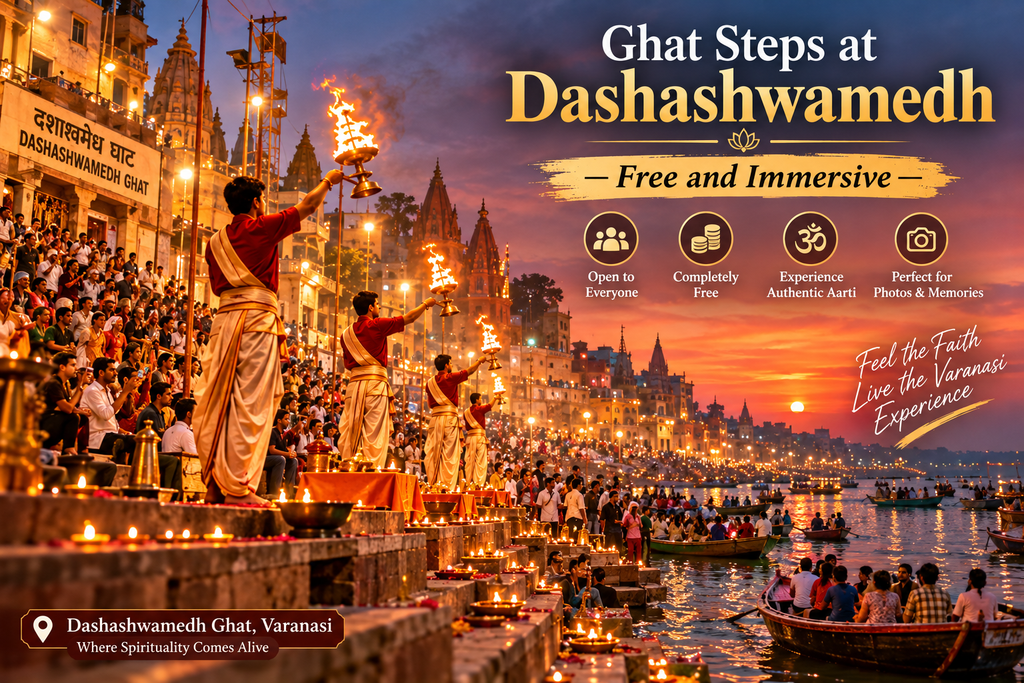
1. Ghat Steps at Dashashwamedh — Free and Immersive
The closest view, full sensory experience. Arrive at least 45 minutes early, 90 in peak season.
2. On a Boat — The Iconic View
See our Varanasi Boat Ride 2026 guide for booking a private rowboat positioned for the Aarti.

3. Rooftop Cafés Nearby
Comfortable, elevated, good for elderly travellers or a second viewing.

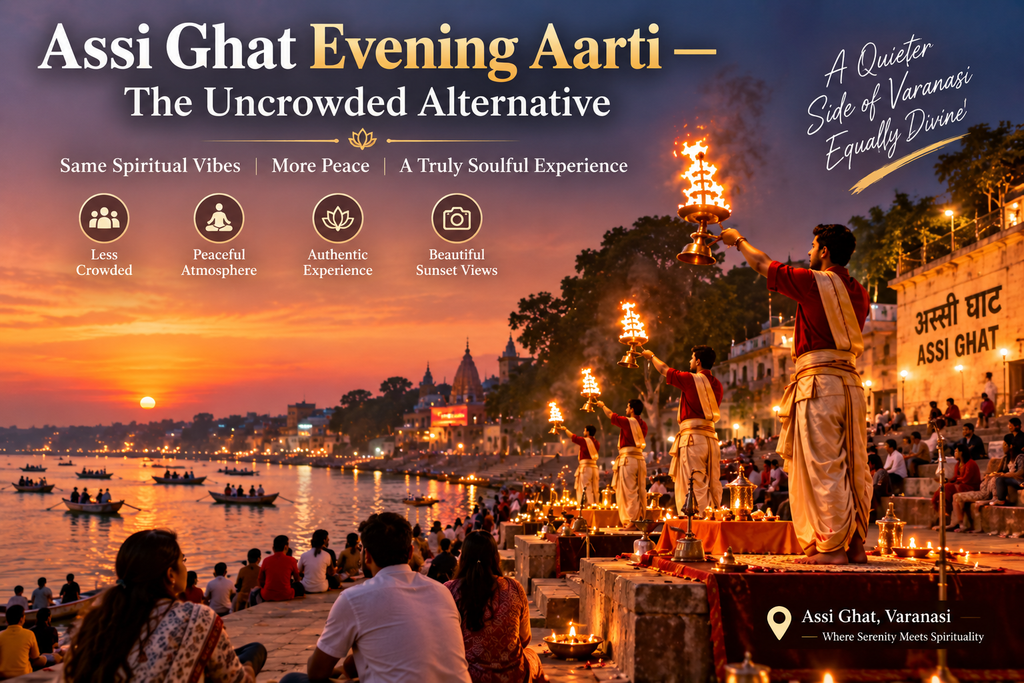
4. Assi Ghat Evening Aarti — The Uncrowded Alternative
Smaller, calmer, attended largely by locals.
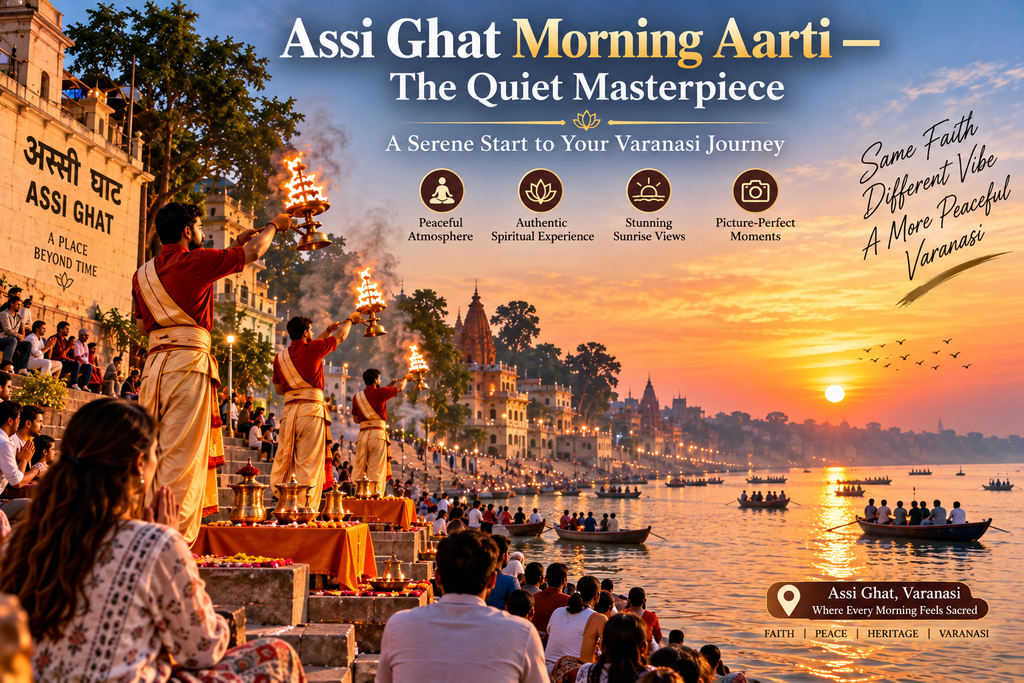
5. Assi Ghat Morning Aarti — The Quiet Masterpiece
Fewer than a tenth of the evening crowd, with mist on the water and ragas at sunrise.
How to Book a Boat for the Ganga Aarti
Boats are available at Dashashwamedh, Assi and several ghats of Varanasi in between:
- Through your tour operator — safest, avoids haggling, and positions are usually secured in advance for the correct Ganga Aarti Varanasi timings 2026.
- At the ghat directly — negotiate firmly, and agree total price, duration and whether it is shared or private before boarding.
- Rowboat vs motorboat — rowboats are quieter, slower, and permitted closer in. For the Aarti, always choose a rowboat.
Typical rates: a shared seat runs a few hundred rupees per person; a private rowboat for the Aarti hour generally costs ₹1,200–₹3,000 depending on season, boat size, and how hard you bargain. Always check for life jackets before boarding — a responsible operator provides them without being asked.
Understanding the Ritual Sequence in Detail
Once you know the confirmed Ganga Aarti Varanasi timings 2026 and have found your spot, understanding the sequence of the ritual makes the experience far richer.
The ceremony follows a fixed order that has remained largely unchanged for generations. It opens with the sounding of the conch shell, a call that quiets the crowd. Bells follow, rung by attendants at each platform. The priests then move through a set sequence of offerings: incense held aloft in slow arcs, a single camphor flame, a multi-tiered brass lamp lifted and lowered in rhythmic circles, a peacock-feather fan, and a ceremonial whisk (chamara). Each offering corresponds to one of the five elements — earth, water, fire, air and ether.
The ceremony closes with flower petals scattered towards the river and the release of small leaf-boats carrying lit diyas onto the water. What most visitors don’t realise is that the priests performing the Ganga Aarti are typically young students of Vedic study under the Ganga Seva Nidhi trust, and the precision you are watching — seven priests moving as one — is the product of years of daily practice.
What to Expect: A Practical Walkthrough
T-minus 60 minutes: the ghat fills; vendors sell diya baskets and chai. T-minus 15 minutes: platforms prepared, incense lit. The ceremony: conch, bells, chanting, lamps. The close: petals offered, crowd surges to float diyas — hold your belongings.
Etiquette and Safety
- Dress respectfully — covered shoulders and knees, appropriate for a religious ceremony.
- Photography is permitted at the Aarti itself, but never at the nearby cremation ghats.
- Do not step onto the priests’ platforms or block the aisle used by ritual attendants.
- Decline unsolicited ritual offers — men approaching with a thread, tilak or “special puja” for a donation are rarely temple-affiliated.
- Guard your phone and wallet closely; the dense crowd at peak Ganga Aarti Varanasi timings 2026 attracts pickpockets.
- If floating a diya, choose the traditional leaf-and-flower kind rather than plastic-based versions, which add to river pollution.
Festival Days and Special Ganga Aarti Varanasi Timings 2026
On Tuesdays, a slightly extended version of the Aarti is performed. On major occasions — Dev Deepawali, Kartik Purnima, Ganga Dussehra and Mahashivratri — the ceremony grows considerably grander, with additional priests, lights strung across the ghat, and sometimes a laser-and-fireworks display over the river. Crowds on these nights are many times the usual size, so the standard Ganga Aarti Varanasi timings 2026 guidance of arriving 45 minutes early stretches to 90 minutes or more, and boats should be booked weeks in advance.
Frequently Asked Questions
Is the Ganga Aarti held every day, in every season? Yes, every single evening of the year, in all weather, without exception.
What is the difference between the Assi Ghat and Dashashwamedh Ghat Aarti? Dashashwamedh is grander, more crowded and more elaborate. Assi Ghat’s version, both morning and evening, is smaller, calmer and often preferred by repeat visitors.
Is it suitable for children and elderly parents? Yes, with planning — choose a boat or rooftop seat rather than the steps, and avoid festival dates if crowd tolerance is a concern.
Is there an entry fee for the Ganga Aarti? No, watching from the ghat steps is free. You pay only for a boat or rooftop seat.
How early should I arrive given the Ganga Aarti Varanasi timings 2026? 45 minutes normally; 90 minutes in peak season or on festival days.
Can non-Hindus attend? Absolutely — the Aarti is open to everyone.
Ghat or boat — which is better? The ghat for atmosphere, the boat for the view and comfort. Do one of each if you have two evenings — pair this with our Varanasi Tour Packages 2026 for a complete plan.
Experience the Ganga Aarti with Sacred Varanasi Tour
Sacred Varanasi Tour arranges reserved ghat seating, private rowboats with life jackets, and guides who explain each stage of the ritual as it unfolds — built around the exact Ganga Aarti Varanasi timings 2026 for your travel dates.
Reserve your Ganga Aarti experience today — boats book out fast in season.