
Sacred Varanasi Tour explains Kashi Vishwanath Temple darshan timings — 7 essential tips on aartis, Sugam Darshan booking, dress code and entry rules.
Kashi Vishwanath Temple Darshan Timings: 7 Essential Tips for 2026
Of the twelve Jyotirlingas across India, none carries quite the gravity of Kashi Vishwanath. Knowing the exact Kashi Vishwanath Temple darshan timings — and the seven things that trip up most first-time visitors — is what separates a rushed, frustrating queue from a genuinely moving darshan.
Shiva is said to reside here permanently, which is why, according to Wikipedia’s page on the Kashi Vishwanath Temple, pilgrims have walked here for millennia believing that dying in Kashi grants moksha.
Kashi Vishwanath’s history is one of destruction and rebuilding. The present structure was built in 1780 by Maharani Ahilyabai Holkar of Indore. The gold plating on the spires — over 800 kilograms of it — was donated by Maharaja Ranjit Singh of Punjab in the 1830s, which is why the temple is often called the Golden Temple of Varanasi. The most recent transformation is the Shri Kashi Vishwanath Dham Corridor, inaugurated in December 2021, which now connects the sanctum directly to Lalita Ghat on the Ganga through a broad processional walkway.

Here are the 7 essential things to know about Kashi Vishwanath Temple darshan timings before you go.
1. Kashi Vishwanath Temple Darshan Timings — The Full Daily Schedule
| Ritual / Session | Approximate Time |
|---|---|
| Temple opens | 2:30 – 3:00 AM |
| Mangala Aarti | 3:00 – 4:00 AM |
| General Darshan | 4:00 – 11:00 AM |
| Bhog Aarti | 11:15 AM – 12:20 PM |
| General Darshan | 12:00 PM – 7:00 PM |
| Saptarishi Aarti | 7:00 – 8:30 PM |
| Darshan (limited) | 8:30 – 9:00 PM |
| Shringar / Shayan Aarti | 9:00 – 10:30 PM |
| Temple closes | 11:00 PM |
After 9:00 PM, darshan is permitted only from outside the sanctum. The Uttar Pradesh Tourism department recommends confirming timings locally during festival months, when the schedule extends.
2. Mangala Aarti — The Most Auspicious Kashi Vishwanath Temple Darshan Timings
Held in the pre-dawn Brahma Muhurta — the hour and a half before sunrise considered the most spiritually charged period of the day — the Mangala Aarti is ticketed and limited to a small number of devotees. Pilgrims who have attended it often describe it as the most intense experience at any Indian temple. Book well in advance through the temple trust or an authorised operator.
Other key rituals through the day include the Bhog Aarti, the midday food offering after which the sanctum briefly closes, and the Saptarishi Aarti, named for the seven sages and performed by seven priests each evening — the most accessible and popular ritual for first-time visitors.

3. Best Time to Visit for a Short Queue
Crowd patterns around the Kashi Vishwanath Temple darshan timings are surprisingly predictable:
- Quietest: 7:00–8:00 AM and 11:00 AM–12:00 PM on weekdays
- Busiest: 3:00–5:00 PM daily, and all day Monday, since Monday is considered Shiva’s day
- Avoid entirely if you dislike crowds: Mondays during Shravan month (July–August), Mahashivratri, and Nag Panchami, when queues can stretch for hours
Pair your visit with the evening Ganga Aarti Varanasi Timings 2026 at Dashashwamedh Ghat, a five to seven minute walk away.
4. Sugam Darshan — Skipping the Queue
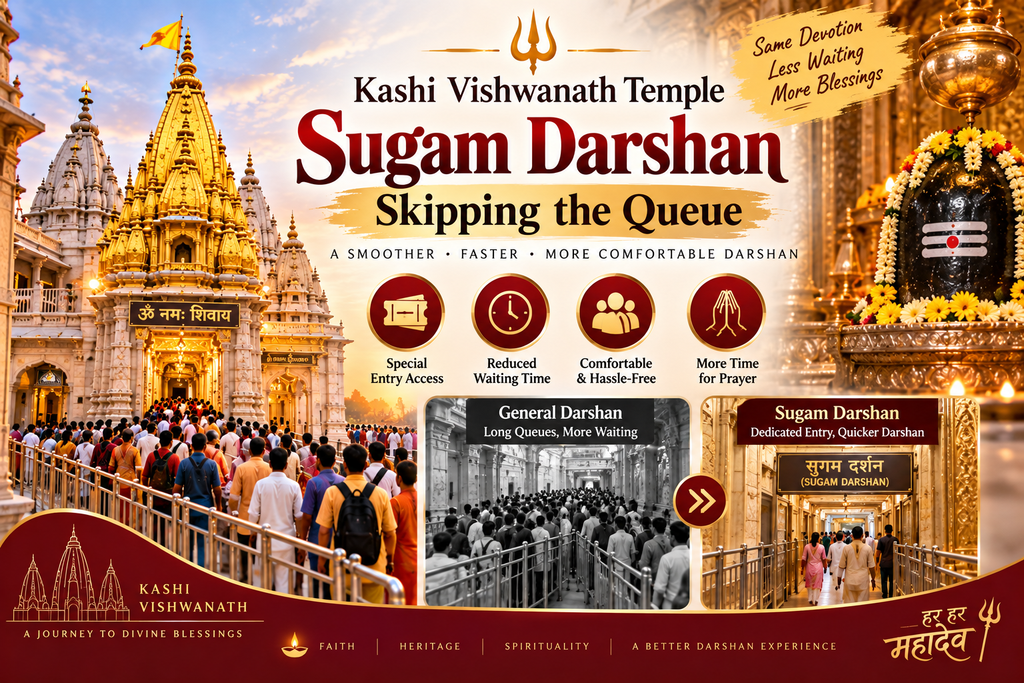
The temple trust’s paid fast-track service, called Sugam Darshan, lets a shastri escort you directly for darshan without the main queue, with special prasad provided. Tickets are priced from a few hundred rupees upward, and children below 12 typically don’t require one. Collect your wristband at the helpdesk before proceeding. Note that Sugam Darshan is not permitted during aarti slots, bookings cannot be rescheduled, and same-day bookings are handled only at the counter, not by phone.
For travellers on a tight schedule, or elderly and differently-abled visitors, this is genuinely the sensible choice within the day’s Kashi Vishwanath Temple darshan timings.
5. Entry Rules and What You Cannot Carry
Security is airport-grade. Not permitted inside: mobile phones, cameras of any kind, bags and backpacks, electronics, power banks and leather items. Free cloakrooms are available near the entry gates for depositing belongings, though queues build at peak hours — the simplest strategy is to leave your phone at the hotel entirely.
Dress code: there is no rigid enforced uniform, but modest traditional dress is strongly expected. Cover shoulders and knees, and avoid shorts or sleeveless tops. Footwear is removed before entry at designated stands. Foreign nationals are welcome at every darshan slot; carrying a passport copy is advisable.
6. What to Offer
Traditional offerings for Shiva are simple and available from stalls near the entrance: bel patra (wood apple leaves, Shiva’s most beloved offering), milk and Ganga jal for abhishek, and white flowers, especially dhatura. Note that tulsi leaves are not offered to Shiva — a detail many visitors get wrong, since tulsi is associated with Vishnu worship instead.
7. Temples to Visit Alongside Kashi Vishwanath
Pair your temple visit with Kaal Bhairav Temple (about 2 km away), the fierce guardian of Kashi whom tradition says you should seek permission from to be in the city at all; Annapurna Devi Temple, adjacent to Vishwanath and dedicated to the goddess of nourishment; and the serene New Vishwanath Temple on the Banaras Hindu University campus, far less crowded and beautiful in its own right. For the full riverfront experience afterwards, walk through the ghats of Varanasi towards Dashashwamedh.
Special Poojas You Can Book
Beyond the standard Kashi Vishwanath Temple darshan timings, the trust facilitates formal rituals for devotees who want deeper participation: Rudrabhishek, the ceremonial bathing of the lingam with Rudram chanting; Laghu Rudra and Maha Rudra, extended multi-priest ceremonies; and special Shringar darshan on festival days. These require advance booking through the trust or an authorised operator.
Combining Kashi Vishwanath Temple Darshan Timings With the Rest of Your Trip
The most efficient way to plan around the Kashi Vishwanath Temple darshan timings is to treat the temple as the anchor of your morning or evening, not a standalone errand. A 7 AM darshan followed by breakfast in the lanes and a walk down to the ghats of Varanasi makes for an unhurried, memorable morning. Alternatively, the Saptarishi Aarti at 7 PM followed directly by the Ganga Aarti Varanasi Timings 2026 at Dashashwamedh Ghat, a short walk away, gives you two of Kashi’s most significant rituals back to back on the same evening.
Frequently Asked Questions
Is there an entry fee for Kashi Vishwanath Temple? General darshan is free. Only Sugam Darshan and ticketed aartis carry a charge.
Can non-Hindus enter? Yes, visitors of all faiths and nationalities are permitted, subject to security and dress norms.
What are the best Kashi Vishwanath Temple darshan timings for a first-timer? A 7 AM weekday visit, followed by the evening Saptarishi Aarti — this combination minimises queues at both ends.
Can I take photos inside? No, cameras and phones are not allowed inside the sanctum area. Photography in the outer Corridor is generally permitted.
How long does darshan usually take? Anywhere from 20 minutes on a quiet weekday morning to well over two hours on a Shravan Monday.
How far is the temple from Varanasi Junction railway station? Roughly 5 km, about 20–30 minutes depending on traffic. Vehicles cannot reach the gates directly, so expect a short walk from the nearest drop point.
Visit Kashi Vishwanath with Sacred Varanasi Tour
Sacred Varanasi Tour handles Sugam Darshan bookings, aarti tickets and cloakroom logistics — so your visit matches the ideal Kashi Vishwanath Temple darshan timings for your dates, not the crowd’s. This fits naturally into our Varanasi Tour Packages 2026.
Get in touch to arrange your Kashi Vishwanath darshan.