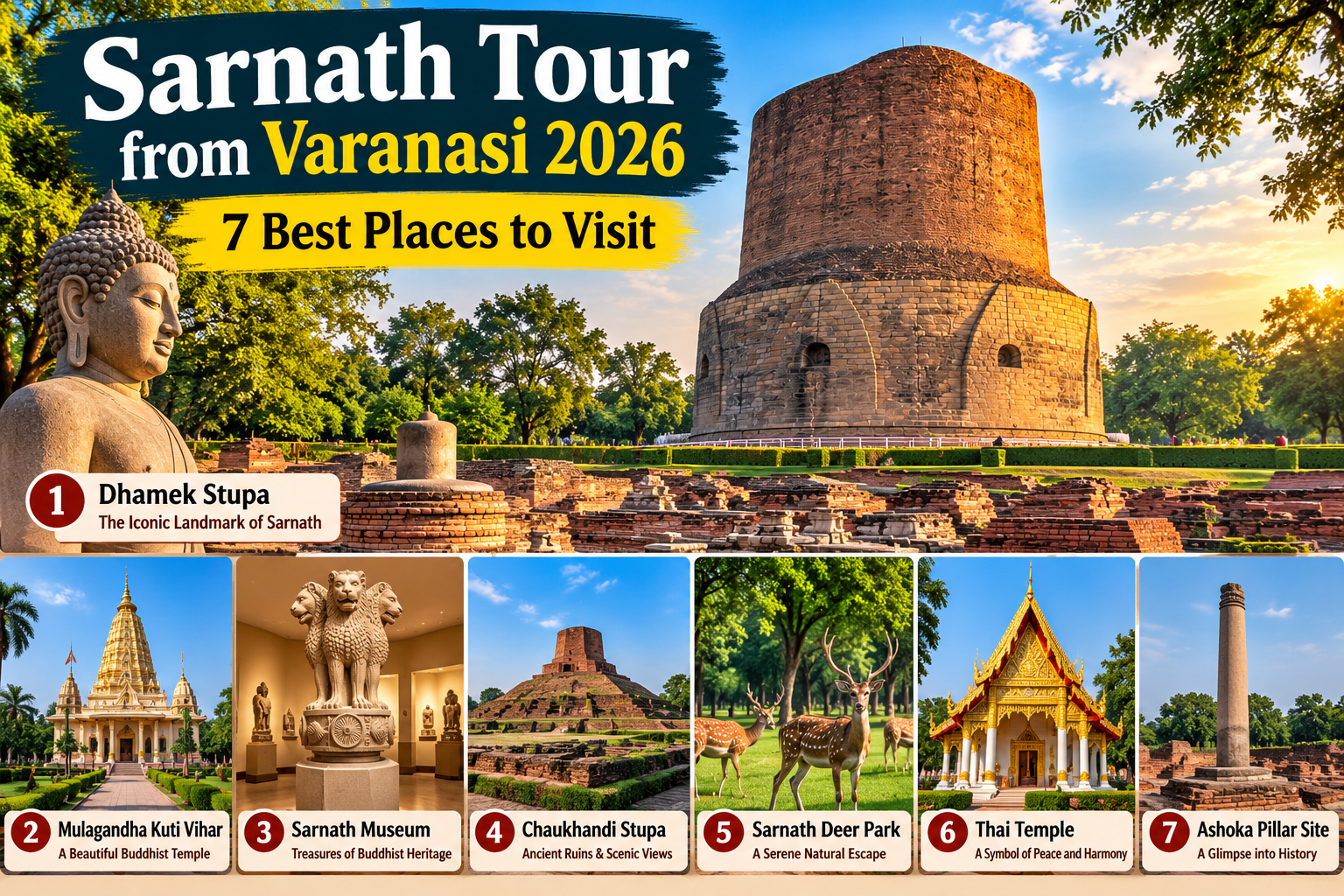
Sacred Varanasi Tour guides you through the best Sarnath tour from Varanasi 2026 — 7 must-see places, timings, entry fees and distance.
Sarnath Tour from Varanasi 2026: 7 Best Places to Visit
Ten kilometres from the noise and fire of the Varanasi ghats lies a place that feels like its opposite: quiet lawns, brick ruins, deer grazing, and a monumental stone stupa. A Sarnath tour from Varanasi 2026 takes half a day and provides the perfect counterweight to the intensity of the city.
Here, around 528 BCE, the Buddha delivered his first sermon after enlightenment, as documented on Wikipedia’s page on Sarnath. The site is protected and maintained by the Archaeological Survey of India, which excavated it in the 19th century after centuries of neglect.
Sarnath is one of Buddhism’s four principal pilgrimage sites, alongside Lumbini (the birth), Bodh Gaya (the enlightenment) and Kushinagar (the passing away). For over 1,500 years it flourished as a centre of learning, until it was destroyed in the late 12th century and largely forgotten, buried under its own rubble until British archaeologists began excavating in the early 19th century.
Here are the 7 best places to see on any Sarnath tour from Varanasi 2026.
1. Dhamek Stupa — The Centrepiece
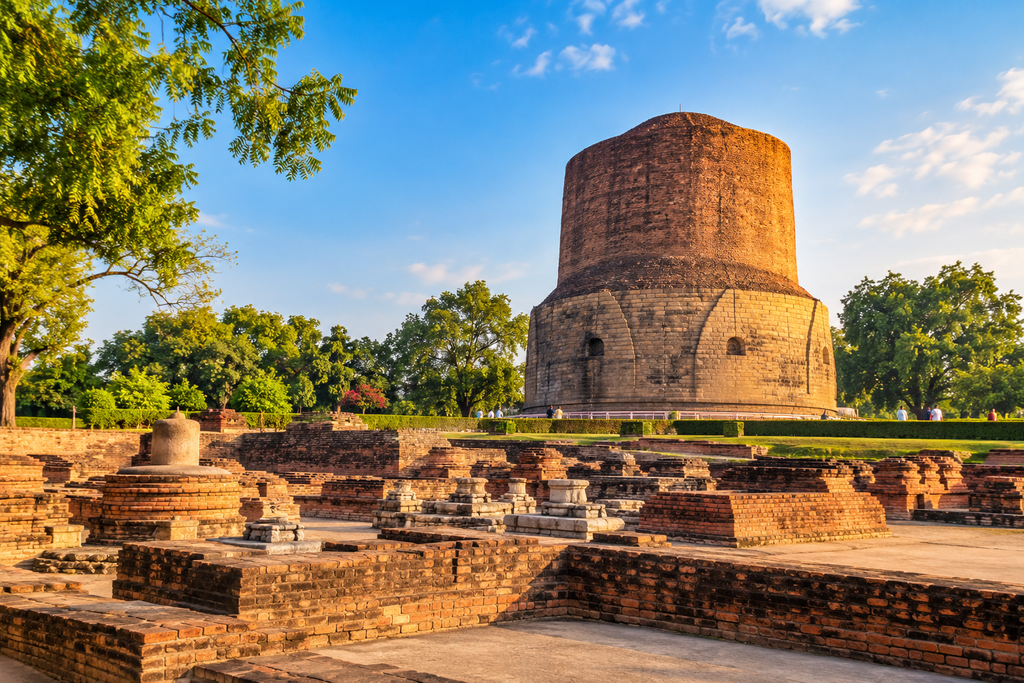
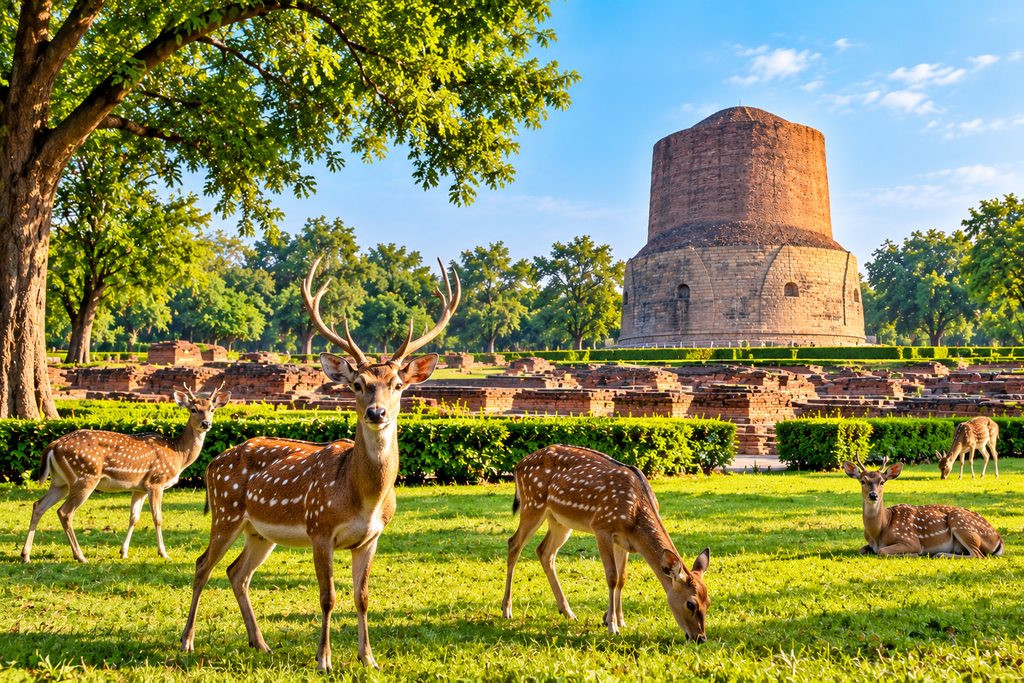
Roughly 43.6 metres tall and 28 metres in diameter, standing on the spot traditionally identified as where the first sermon was delivered. The present structure dates to around 500 CE, built over an earlier Ashokan-era stupa. The lower section is faced in dressed stone, carved with delicate floral and geometric bands — Gupta-period craftsmanship of the highest order. Walk clockwise, as pilgrims do. Allow 20–30 minutes.
2. Dharmarajika Stupa Ruins and the Ashoka Pillar
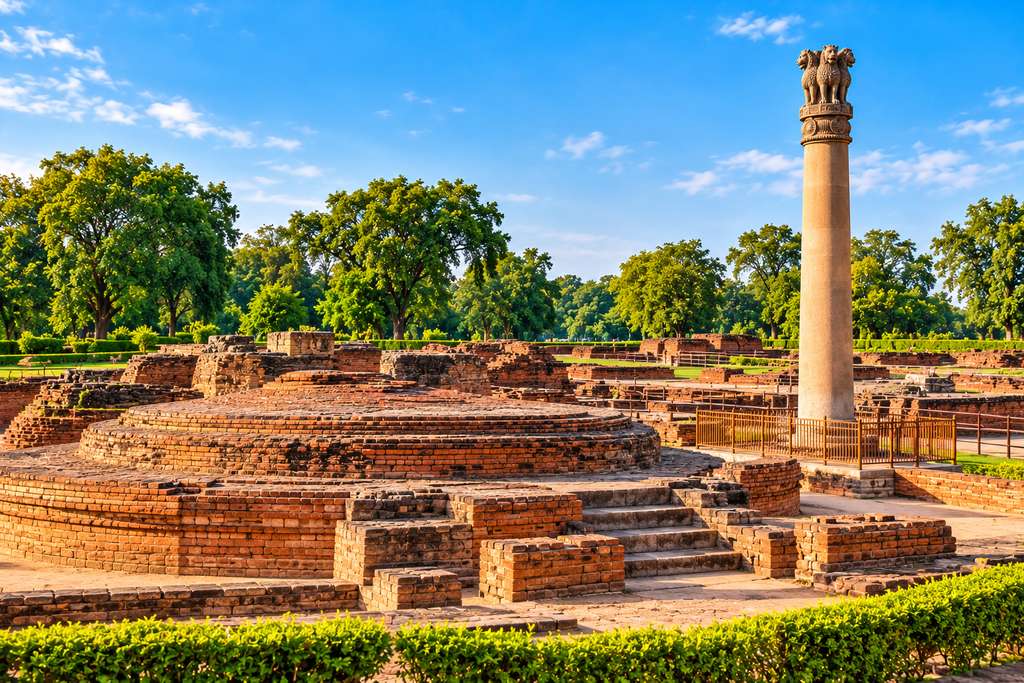
Foundations of monasteries, shrines and a vast Ashokan-era stupa spread across manicured lawns. The Ashoka Pillar stands here in fragments — the shaft still in position, protected by a railing, its famous lion capital now preserved in the museum. Look for the Ashokan edict inscribed on the pillar, warning against schism within the monastic community. Allow 30–40 minutes.
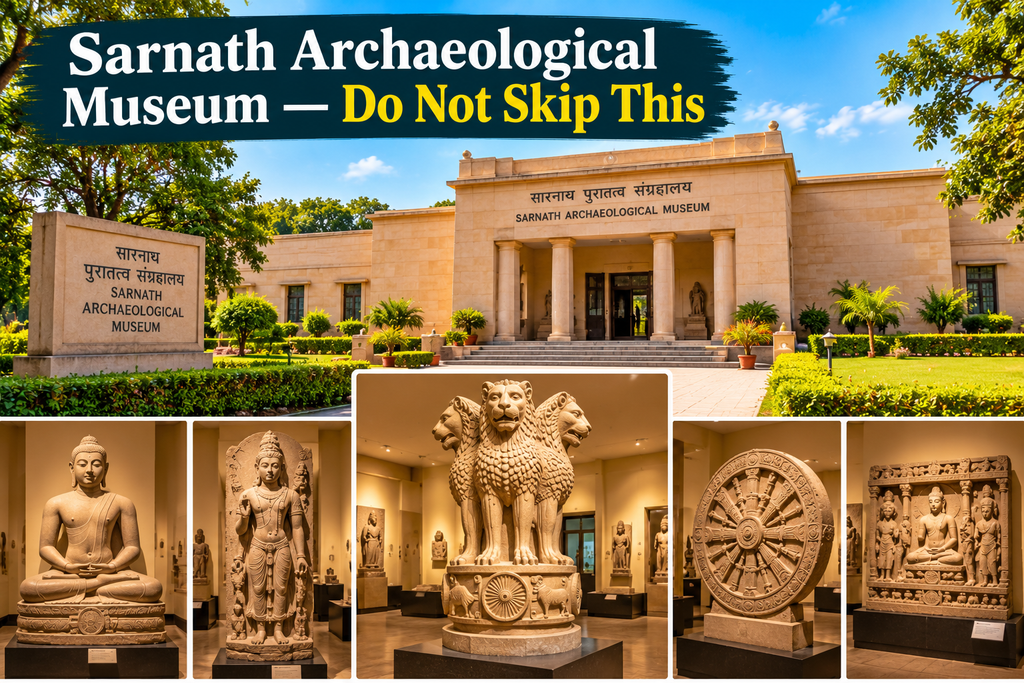
3. Sarnath Archaeological Museum — Do Not Skip This
India’s oldest site museum, opened in 1910, home to the Lion Capital of Ashoka — four lions back to back on an abacus bearing four animals and four wheels, carved from Chunar sandstone and polished to a shine that has survived over 2,300 years. This is India’s national emblem, and the wheel on the Indian flag is drawn directly from its base. Also here is an exceptional seated Buddha in Dharmachakra Mudra from the Gupta period, widely regarded as one of the finest Buddhist sculptures ever made. Timings are generally 9:00 AM–5:00 PM, closed on Fridays. Cameras and mobile phones are not permitted inside; lockers are available at the entrance. Allow 45–60 minutes.
4. Mulagandha Kuti Vihara
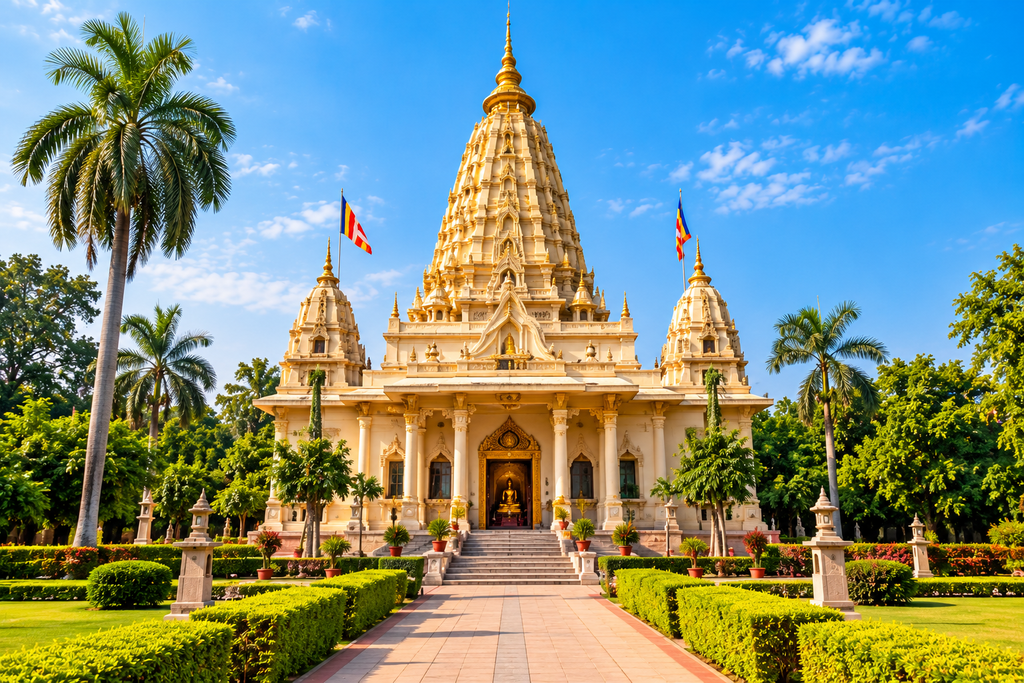
Built in 1931 by the Mahabodhi Society, founded by the Sri Lankan reformer Anagarika Dharmapala, who did much to revive Sarnath as a pilgrimage site. The interior is covered in murals by the Japanese artist Kosetsu Nosu depicting the Buddha’s life, and the temple houses relics of the Buddha recovered from Taxila. A Bodhi tree in the grounds was grown from a sapling of the tree at Bodh Gaya. Allow 20 minutes.
5. The Deer Park
Beside the temple, a small enclosure where deer are kept, referencing the original Mrigadava — deer park — where the Buddha taught. Children enjoy it, and adults find it a pleasant place to sit and rest between sites.
6. Chaukhandi Stupa
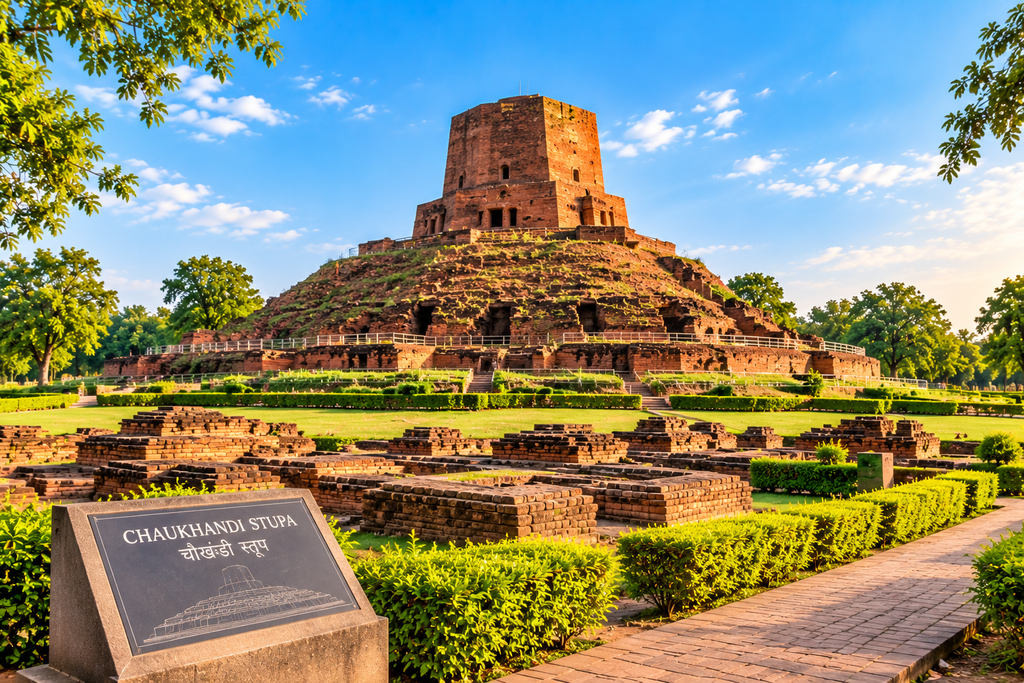
An octagonal Mughal tower sitting incongruously atop a Gupta-era brick mound, marking the spot where the Buddha is said to have met his five former companions. The tower was added in 1588 to commemorate a visit by Emperor Humayun. About 1 km from the main complex, and worth the short detour on your way out.
7. The International Monasteries
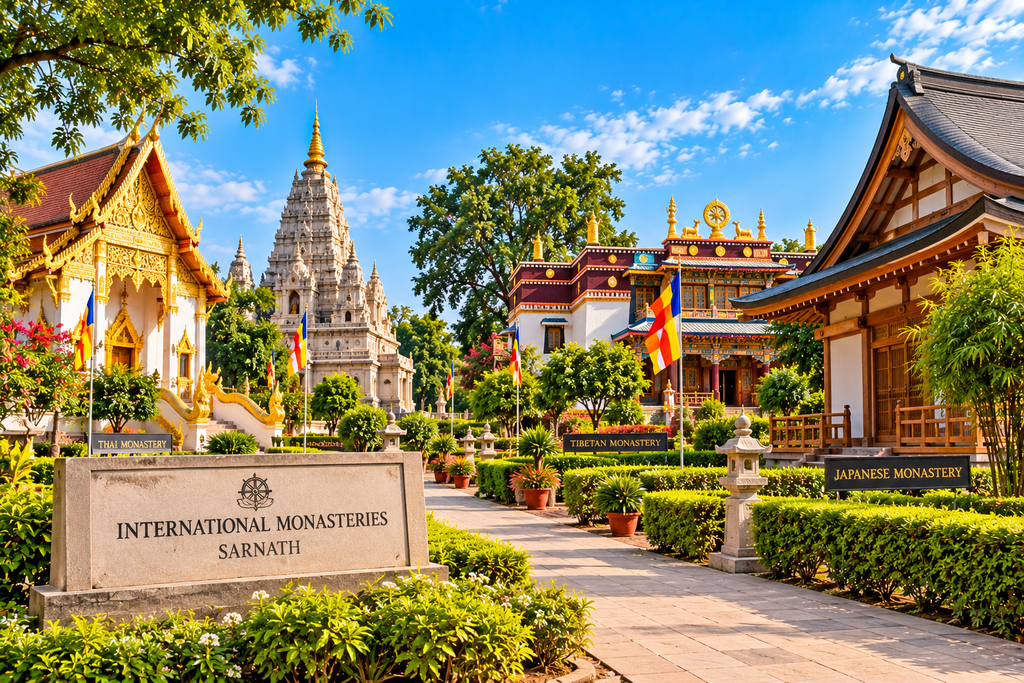
Sarnath hosts temples built by Buddhist communities from Thailand, Japan, Tibet, Myanmar, China, Sri Lanka, Korea and Vietnam, each in its own national architectural style. Walking between them in an afternoon is like touring the Buddhist world in miniature — the Thai Temple with its enormous standing Buddha statue and the Tibetan Temple with its prayer wheels are the most visited, and a highlight of any thorough Sarnath tour from Varanasi 2026.
Sarnath Distance from Varanasi and How to Get There
Sarnath lies about 10 km northeast of Varanasi, roughly a 30–40 minute drive. A private car with a waiting driver is the sensible choice for a half-day trip; pair it easily with our Ghats of Varanasi morning walk on the same day.
| Mode | Time | Approx. Cost |
|---|---|---|
| Private car (AC) | 30–40 min | ₹800–₹1,500 return with waiting |
| Auto-rickshaw | 40–50 min | ₹400–₹700 return |
| Local bus | 60 min | ₹30–₹50 |
A Suggested Half-Day Sarnath Itinerary
8:30 AM depart Varanasi → 9:00 AM Archaeological Museum → 10:00 AM Dhamek Stupa and ruins → 11:00 AM Mulagandha Kuti Vihara → 11:30 AM Thai and Tibetan temples → 12:15 PM Chaukhandi Stupa → 1:00 PM return for lunch.
Best Time for a Sarnath Tour from Varanasi 2026
October to March is ideal — mild and clear. Buddha Purnima (April/May, on the full moon) is the most significant day of the year here, marking the Buddha’s birth, enlightenment and passing, with large gatherings and processions. Avoid midday in May and June, when the lawns offer little shade. Check our Best Time to Visit Varanasi guide to align both trips on the same dates.
Entry Fees and Practical Details
The main archaeological site is ticketed, with separate rates for Indian nationals and foreign visitors; children below 15 are typically free. The Archaeological Museum requires a separate nominal ticket and is closed on Fridays. The Mulagandha Kuti Vihara and international temples are free to enter, with donations welcome. Footwear is removed at temple entrances, and facilities include clean washrooms and drinking water near the main gate — food options are limited, so plan to eat in Varanasi.
Extending Your Buddhist Circuit
If a Sarnath tour from Varanasi 2026 sparks something, Varanasi is a convenient base for a wider Buddhist journey. Bodh Gaya, 250 km away and about 6 hours by road, holds the Mahabodhi Temple and the Bodhi tree. Kushinagar, also 250 km, marks the site of the Buddha’s passing. A four-to-six-day Buddhist circuit from Varanasi covering Sarnath, Bodh Gaya and Kushinagar is a well-established route for travellers who want to go deeper than a single day trip.
Frequently Asked Questions
How far is Sarnath from Varanasi? About 10 km, a 30–40 minute drive.
How much time do I need for a Sarnath tour from Varanasi 2026? Three to four hours for the main sites; a full day for the international monasteries too.
Is the Sarnath museum open every day? No, it is closed on Fridays.
Can I combine Sarnath with Kashi Vishwanath in one day? Yes, easily — see our Kashi Vishwanath Temple Darshan Timings guide for pairing both in a single day.
Is Sarnath suitable for non-Buddhist visitors? Entirely. It is as much an archaeological and art-historical site as a religious one, and the museum, protected by the Archaeological Survey of India, is of national importance regardless of faith.
Are photographs allowed at Sarnath? Yes at the outdoor stupas and ruins. No inside the Archaeological Museum.
Plan Your Sarnath Tour from Varanasi 2026 with Sacred Varanasi Tour
Sacred Varanasi Tour arranges half-day and full-day Sarnath excursions with an AC vehicle, a guide trained in Buddhist history, and pre-arranged tickets — all built into our full Varanasi Tour Packages 2026.
Contact us to add Sarnath to your Varanasi itinerary.